Showing posts with label Hypothesis. Show all posts

Tuesday, 2 February 2016

Wormhole Dyanmics: The EVE Gate

Jove, Sleepers and Talocan have all been known to be able to manipulate wormholes, even before the Seyllin Incident. So far the only explanation for this is that they are ancient races in possession of handwavium, allowing them to do so. But if you've agreed with me so far, you're ready for the big reveal.


For our current natural wormholes to appear, you need a source of gravitational wave. For capsuleers, this was provided to us by the Seyllin Incident, literally thumping reality hard enough to produce the waves.


The Drifters, Rogue Drones and Sansha have all demonstrated their capacity to at least control static wormholes with structures in space. I've assumed that these are, in fact, wave generators. However, we know that some Jove and Drifter ships are capable of producing wormholes on their own, perhaps using on board generators.


But what if you were an advanced civilisation, with the capacity to build structures such as the Jove Dyson cloud? Would you be satisfied with only being able to use natural gravitational waves to travel through space? Like sailors before steam engines, you'd be at the mercy of the winds. What if there were some way you could generate waves enough to supply a system? What if it were big enough to supply a whole cluster with a steady supply of gravitational waves to form standing wave bridges?


The EVE Gate.


It is a colossal gravitational wave generator, supplying New Eden with a reliable source of gravitational waves.


Think again back to the Seyllin Incident being a stone thrown into space-time, causing these ripples. Usually these oscillations would simply disappear over time, the energy lost by the moving wave. The reason we still have the effect of wormholes, and indeed the increase in wormhole activity, is that something is adding waves into the cluster.


Again, a practical examples would be this; go to a sink, and fill it with water. Put your hand on the surface, and push up and down gently. You'll soon start to see the water moving up and down like crazy, forming the peaks and troughs of standing waves. Your hand, in this case, represents the EVE Gate.


Now we know why it is impossible to approach. The storms raging around it is the quite literal upheaval of space-time. Ships that approach are likely to be shaken apart by the gravitational stress.


In the beginning, this was quite stable. But now, as time goes on, the technology is starting to fail, and the wave generator experiences some periods where it does not oscillate at its maximum strength. These are the periods which allow the Sisters of EVE, or just the curious, to go and look closer.


Some of you will now say that we know our ancestors passed through the EVE gate to enter the New Eden cluster. I don't dispute that. However, I can say that perhaps the wormhole they passed through was not the Gate itself, but probably a wormhole produced by resonating with it.


And now we can say why the EVE Gate is perpetually producing light. It is the energy given off by the frequent oscillation in space-time... an effect we see mirrored in other wormholes.


That's pretty much the end of what I have to say about my hypothesis. It's probably not the explanation for how things actually work in New Eden, but it was a very happy thought I had, that seemed to get everything to line up. In any case, I hope you had fun working through my mad ramblings. I also hope you picked up on some real world Physics, and maybe are a little inspired to go and find out more.

Monday, 1 February 2016

Wormhole Dynamics: The Seyllin Incident

If you've followed me down my rabbit hole this far, you have both my thanks and admiration. Takes a good deal of patience to read through the ramblings of a mad man.


But now we've hit a real pay off in explaining one of the more major events in EVE, the Seyllin Event.


Recall that the Seyllin Incident was the detonation of vast quantities of Isogen-5, causing a vast chain reaction that destroyed several planets, and began the first appearances of natural wormholes in New Eden. Capsuleers were now able to enter Anoikis space, and scavenge amongst the civilisations resident there.


The intent behind this detonation aside, we can now say why it caused the appearance of wormholes using the gravitational wave model.


The detonation of Isogen-5 caused a massive fluctuation in space-time. Yes, that sounds like science fiction gone wild, but all it means is that 4-d space received a huge pulse. We basically moved the rubber sheet of reality up and down.


As an example, drop a rock in the middle of a pond. You generate a series of waves, propagating away from where you dropped the rock.


This pulse combined in several places, adding to other gravitational waves bouncing around the cluster. In some cases, the amplitude was of such magnitude as to dump huge amounts of energy onto planets, shattering them. These shattered planets are all in orbit of Ao-Blue class stars, and are all the first ones in their system. Now we can say why they were destroyed, perhaps without the need for Isogen-5 caches.


The pulse sent out by the detonation had a certain amplitude. These stars just  happened to be at the right distance from the epicentre. They also may have had a similar effect on space-time around them. In essence, they all bend the rubber sheet of reality the same way. What may have happened as the pulse passed through the system is the same effect as a wave crashing on a beach.


The pulse simply lost it's energy as it passed through the contortion of space time caused by the Ao-Blue star. Just like when a water wave hits the shore, what was once a gentle oscillation turned into a great wall of energy crashing down onto mass... and of course, the rocky planets bore the brunt of this.


These planets were literally hit with a gravitational tsunami.


The resulting waves reflected from other massive objects, and any other sources of gravitational waves, then started to form the great rolling mess of gravitational waves needed for the first natural wormholes to appear.


That is what opened up Anoikis to capsuleers. We are now living in space-time which is fundamentally different from what was here before.


But you may be wondering how the Jove and other ancient civilisations were able to harness these waves before the event. I'll expose this idea to public opinion before getting to that... as it is getting even deeper into assumption and what ifs...

Sunday, 31 January 2016

Wormhole Dynamics: Wormholes as Standing waves

Now for the development of wormholes as standing waves, giving us startling explanations and implications for wormholes in New Eden.


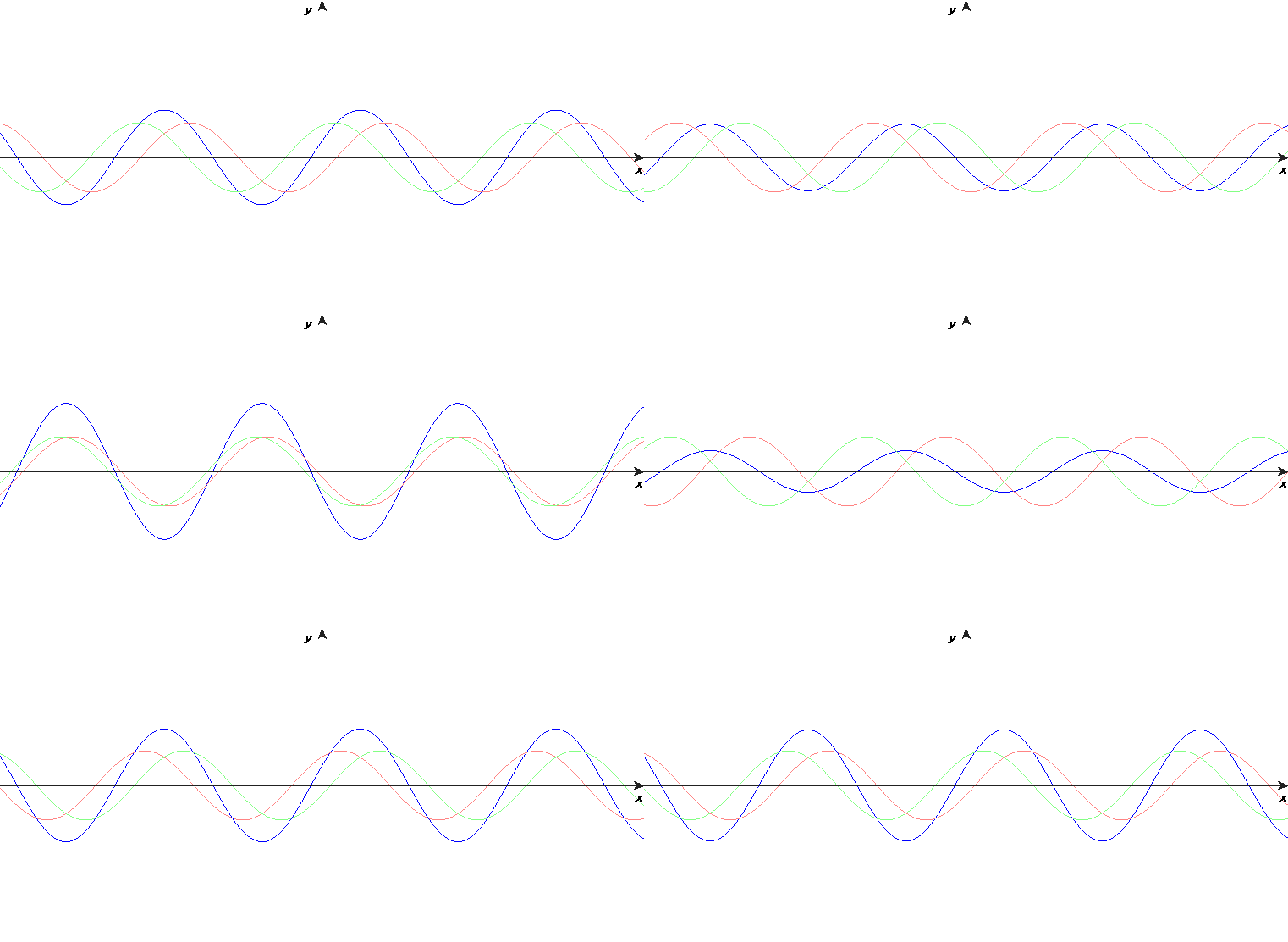
Recall my post on standing waves? The ones that look like this:
This shows how two waves can come together to form what appears to be a static oscillation in a medium. My example before was a rope, but now we're going to apply this idea to a rubber sheet analogy of space time.
For a start, space-time is 4-dimensional. It's not nearly so easy to imagine a wave in this environment, without lying a little to ourselves, and pretending the universe is one big sheet of rubber. I'm also assuming here the maths works out. I'm still at the beginner stages of tensor calculus, and so can't prove it yet.
The idea is this:
  • Gravitational waves are generated at two sources at a distance from each other.
  • As they move towards each other, they form a standing wave in between them.
  • The peaks in the waves add to each other to cause the necessary contortion of space-time.
  • Elsewhere in the universe, a similar event happens.
  • These two peaks join each other, as discussed in the previous post.
This is possibly how wormholes in New Eden are formed. From this model, we can now see why wormhole space is sometimes dominated by large mass objects, such as black holes and pulsars. These large objects are causing the necessary gravitational waves to produce natural wormholes. They are also "lowering" the surrounding space-time to make such peak to peak connections easier.
This also explains why wormholes have seemingly random destinations, whilst statics are known to remain in place.
Statics are locations in space where gravitational waves are somewhat constant. There is an ebb and flow of amplitudes, the energy of the waves, but these places are where standing waves can easily form. Essentially, it is a place where a number of gravitational waves comes together to form the peak needed to bend space-time into the wormhole bridge.
However, the exit location is not always the same. This is because, unlike the two black holes joining model, the other locations wave peak is not always fixed. What the static wormhole will do is fix itself to the "closest" possible wave peak. I say "closest", because at this point distance becomes a very tricky concept.
Imagine this: Rather than New Eden's space time being a fairly even and calm pond, like a smooth rubber sheet, it is more like a rolling ocean, with waves and tsunamis crashing around all the time.
See the area in between the two spheres?


A standing wave can readily form there, treating those two circles as fixed points. Now it's unlikely for a spherical object to produce a gravitational wave, so those two spheres really just represent wave generators.


The idea of random wormholes forming due to massive objects bending space-time doesn't work. For New Eden's wormholes to vanish and appear, we would need masses appearing and disappearing, seemingly at random.


But if these waves are so prolific in the cluster, shouldn't we feel the effects? Wouldn't time and space be warping all the time, making space travel, and just general communication a nightmare?
The reason we don't see the effects of gravitational waves, beyond wormholes, is that the gravitational waves are pathetically low energy. The only time they are strong enough to cause an effect on mass is when we have these standing waves, resonating and adding to each other to increase the amplitude of the wave.
 Now we can say why the Drifter wormholes and Sansha wormholes are constructed the way they are.

The structures are placed there to create an artificial gravitational standing wave, which can then link up to whatever location they desire.

We can also extrapolate from here, by saying that some ships may be able to carry gravitational wave generators to produce short term standing waves. These will not be as stable as the gated ones, meaning that only some locations are favourable.

If this is the case, we can now explain why the Seyllin Incident caused the appearance of random wormholes, and perhaps present a new perspective of the function of the EVE Gate itself.

Saturday, 30 January 2016

Wormhole Dynamics: Gravitational waves and Wormholes


So now we're going to bring this all together, which should present us with a good model for understanding wormholes in EVE, and from which we can extrapolate to both the mechanics of the Seyllin Incident, the mechanism of the Jove Dyson cloud network, and even the function of the EVE gate.


See, I told you it was a happy thought.


The idea behind wormholes, as predicted by relativity, is that 4-d space-time is manipulated in such a way as to create a bridge from one location in space time to the next.


I covered this already. The issues arise with that negative energy in the throat of the wormhole. Remember that the acceleration due to gravity is so strong there that not even light can escape, meaning that travel across it is fairly impossible. There must be some mechanism or some exotic matter to make that jump possible.


At least if you were a particle.


Waves, on the other hand, are all about the transfer of energy rather than the movement of particles. Indeed in a wave, although there's definitely something moving, particles do not, in fact change their location in the direction of movement. They oscillate up and down, but they don't go forward and back.


More on that in a second.


The wormholes are generally thought to be made by large masses causing contortions in space-time. Fairly simple to understand in terms of the rubber sheet model. You get two masses pushing down at the same time, and they may connect.


But that's not the only way to get a rubber sheet to move. And caveat  now, this is where the Science becomes mostly fiction. I'm not good enough to put the numbers to this hypothesis yet.


We can also get our sheet to move by applying a wave. In the case of space-time, a gravitational wave.


If we get the peak and trough of two gravitational waves to link up, then we can also create the bridge between two locations in space. Which is super exciting!

Placeholder for better image


The large mass model is static. Once the bridge is made, it's there until the energy is all lost from radiation of exotic particles. The formation of them also needs an awful lot of matter to cause the contusion of space-time. Not something a ship can reliably carry around with it.


The waves don't need as much mass, just an oscillation of local-space time. Ok, we need moving masses for this to happen, but the key point here is that the mass does not need to be IN the wormhole.

This goes a long way to describing how our ships can seemingly shift between locations in space at low energy. At the centre of the wormhole as we see it, our ships actually catch the anti-node of the wave as it becomes flattened into 'normal' space-time.


As the wave then oscillates back to it's peak, our ships are carried with it, and cross over to the other wave peak as it comes in. When the second wave flattens out again to 'normal' our ships are deposited back into a new location, and our autopilot moves us away from the peak area where this exchange happens.


This is why all ships have the same entry distance to wormholes, and larger ships with more mass appear further away. More massive ships must move further away so as not to be caught in the wormhole oscillation again. Less massive ships are less affected by the contortion of space time.


This now explains why wormholes in New Eden have a lifetime based on the mass of objects passing through. Massive objects around the wormhole act as dampening. The more massive objects that pass through, the greater the dampening effect. The energy of the wave is absorbed in moving the ships from one location to the other. Once enough energy is absorbed, the amplitude of the wave falls so that it no longer causes these bridges in space time.


It also explains why light from the other side of the wormholes is able to pass through without colour changes due to gravitational red shift. It is quite literally being carried from one section of space on the gravitational wave, rather than having to pass into and out of a very high gravitational field.
It's also consistent with the ripple effect we see being emitted from wormholes. They move, rather than being static.


There is so much more to talk about, but I'll expose this to public opinion first. But if this is correct, or at least good enough for EVE, then we can now explain random wormhole appearances, ship board wormhole generators, the exact reason for the Seyllin Incident, and what the EVE Gate actually is.


Additional: If anyone can help me make a nicer image for this waves touching idea, please get in contact... I lack the graphical skills.


Friday, 29 January 2016

Wormhole Dynamics: Standing Waves

This is a bit of relatively simple Physics that you've most likely seen before, and has a lot of application in The Real World outside of the lab.


Warning: This may not look like much when it comes to EVE, but it is vital to understand this model of wormholes. Bear with me... it will all make sense soon.


You'll mostly be familiar with a travelling wave, like the gravitational ones we saw last time. These waves appear to move in a certain direction. The peak of the wave looks like it's moving forward.


Standing waves are exactly what they say they are... waves that appear to not propagate forward. The peaks still move up and down, but they're not going anywhere.


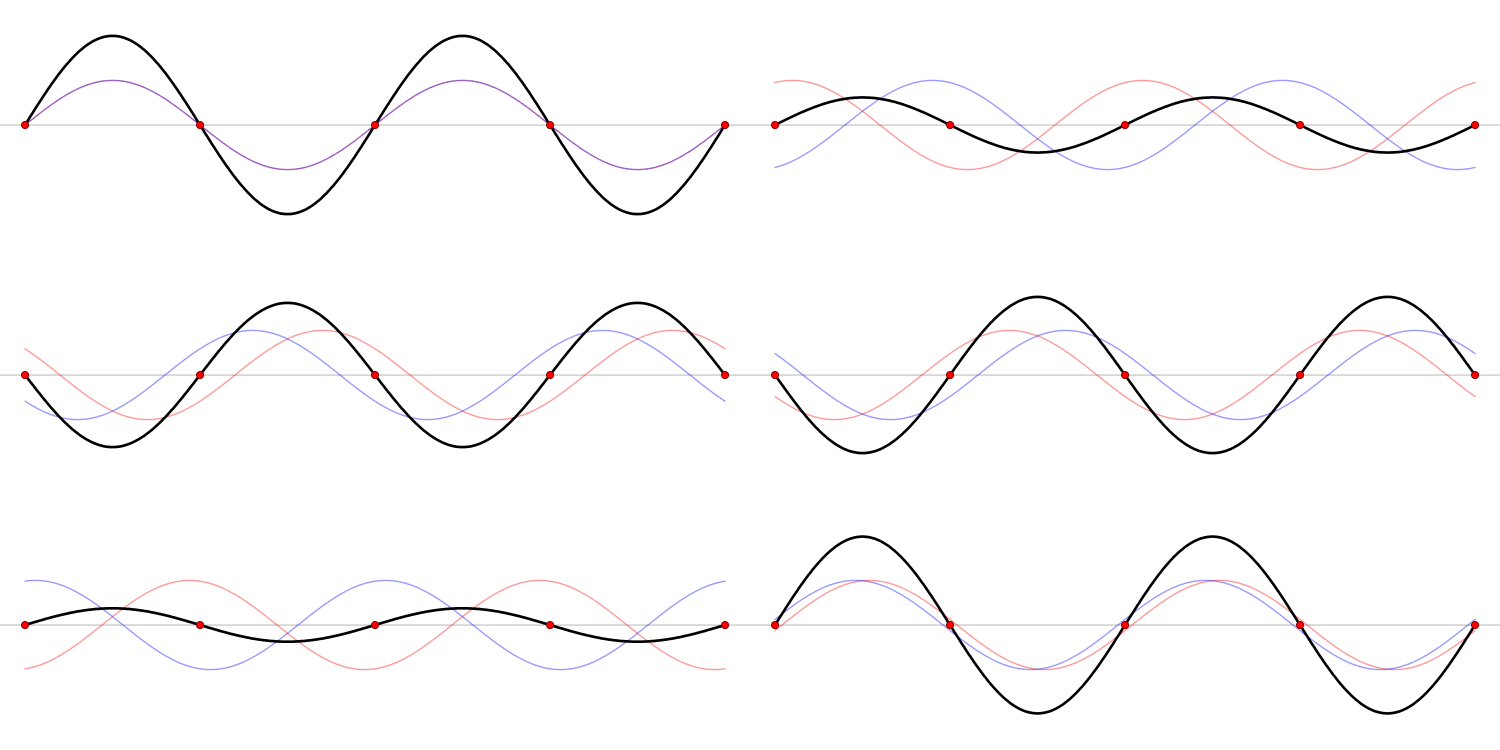
This is an example of one. See how it goes up and down but doesn't appear to travel?


Well this is actually what happens when a waves reflection is added to itself.


Imagine that thick black line is a rope, and you're at one end of it. Your flick the rope up and down, creating a little pulse down the rope. If it's not attached to anything, well, that pulse will just kind of disappear when it gets to the end.


However, if you then fix that end to a wall, the pulse will be reflected back at you.


If you keep moving the rope up and down, oscillating it, you will produce a travelling wave down the rope. Nothing you've never done before. Now imagine that the wave you send down the rope is the faint blue line in the image above.


Of course, the wave you send is going to be reflected back, just like the pulse earlier. That wave must travel down the rope just like the one you send. This is shown by the faint red line in the above image.


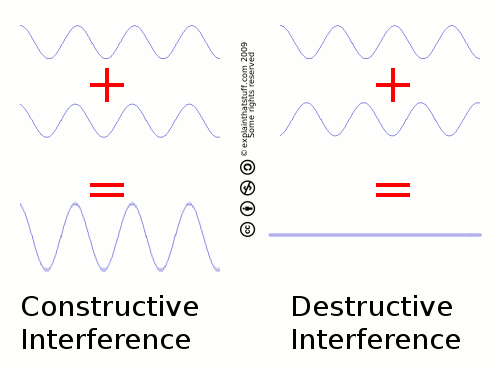
It turns out that waves that pass through each other just add themselves. So when the peak of the reflected wave meets the peak of the incoming wave, they add to produce a very big peak. If a trough adds to a peak, we end up with nothing happening.


In a standing wave, the peaks are always in the same place, and there are certain areas on the rope where nothing is happening. The stationary points are nodes, and the peak parts are anti-nodes.
This concludes our Physics lesson for today, and in the next post we'll start bringing these ideas together to my happy thought.


If you'd like to see a standing wave, grab yourself a piece of string now, attach it to something and start wiggling it. You should get a standing wave. If you don't have string, the best way to see a standing wave is to go get up on your feet, and go to a mirror. When in front of the mirror, raise your right hand (or left depending on dominance). Then, gently oscillate your hand back on forth. You should see someone doing a standing wave.


... You'd be surprised how many people won't get that.

Thursday, 28 January 2016

Wormhole Dynamics: Gravitational Waves

The first step to understanding this model, is to remember one of the basic ideas behind relativity.


Space-time is almost like a blanket or rubber sheet, stretched across... um, we'll leave that analogy there. But imagine it as a stretched sheet. Put some massive objects on it, and it will distort the sheet, giving some nice gentle valleys and pits. Gravity is merely the acceleration experienced by an object as it falls into one of these pits.


This was Einstein's idea, and spawned a vast array of new and wonderful ideas and hypotheses, one of which was gravitational waves.


Put simply, the sheet can have waves moving across it, just like waves on the surface of the ocean. These fluctuations in space time are gravitational waves.


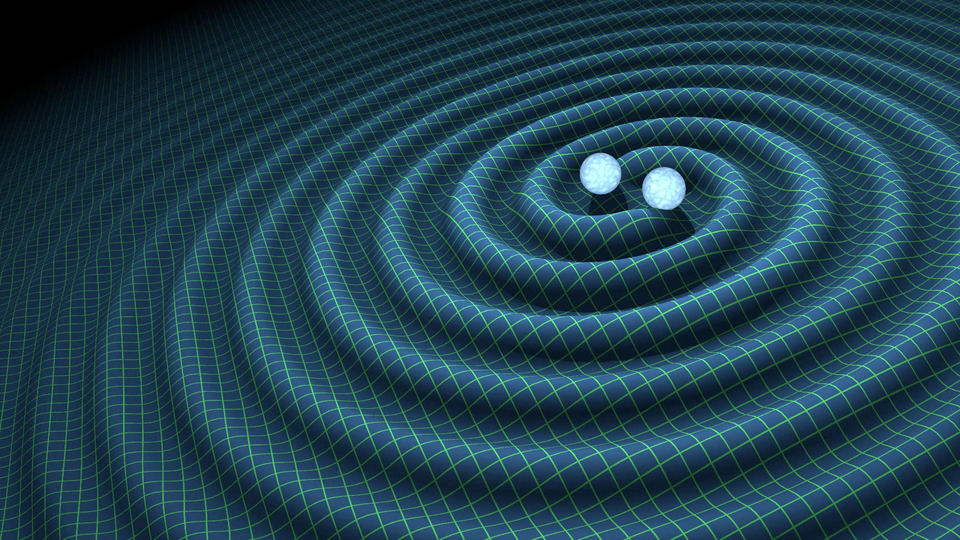
These ripples can be generated by two massive objects orbiting each other, as shown by this picture here of two neutron stars orbiting each other.


See how the distortion in space time propagates away from the stars?


These are phenomenally hard to detect, and there is a search right now to find them. The evidence we have for it now really just involves seeing a slow down in orbital speeds of two known neuron stars orbiting each. This lost energy must go somewhere, and it is believed it's carried off by this gravitational waves.


The reason they are so hard to detect is because gravity is actually a fairly weak force. It takes an awful lot of matter to make an appreciable gravitational field (which you know, since it's taking the whole mass of the Earth to keep you from flying into space...). The gravitational wave is obscured by all the other forces around us. Even my above example is in dispute.

However, in New Eden we already have fairly hard evidence for things which should only be hypothetical. Black Holes are merely mundane window dressing to wormhole corps shenanigans, and wormholes themselves are prolific to the point of common feature. What I am suggesting, and will be building from, is the idea that gravitational waves are not only present in New Eden, but actually strongly affecting the cluster.

Wednesday, 27 January 2016

Wormhole Dynamics: A happy thought...

Every so often, the hundreds of thoughts you have per day neatly line up into one coherent idea.


It happened to me a week ago, and I've been happily doing the crunching and analysing for the past few days.


The first thought that came in was when I was preparing a lesson on Standing waves for my students. They're not too tricky to wrap your head around, but the maths can look difficult if you're not used to describing with equations. Typically this is where we sort the experimental from the theoretical Physicists (the engineers having bee identified from the previous topic on microwaves, and measuring the speed of light using toast and a microwave oven).


I was just looking for some examples of standing waves that were different from the normal laser and musical instrument stuff, and came across a gravitational wave. Quite cool, but not really what I needed, so I moved on.


In the evening I happened to read up this post from Rhavas, talking about the latest chronicle, and the sweeping conclusions to months, and indeed years, of research and analysis. In it my own findings of a closed wormhole system were confirmed, along with my reasoning for it. He, and a number of commenters go on to predict doom, gloom, and the coming of a super-powerful race of technological wizards.


I read, and in typical capsuleer fashion, wondered just how such a new race would eventually be farmed for scrap and loot.


It did bring back to the fore of my mind, just how prolific wormholes in New Eden are, and sent me back to my project of understanding how wormholes worked in our cluster. The recent chronicle had confirmed that they were mostly artificial, a remnant left by accident or design from the Talocan.
After butting my head against the same brick wall for a few hours, trying to get everything to work, I gave up in frustration and turned on the TV.


As luck would have it, The Big Bang Theory was on, a re-run of an old episode. You, of course, are entitled to your own opinion, but as a Science teacher and eclectic nerd, the show resonates with me. And in this particular episode, Sheldon was equally frustrated with a problem he couldn't solve with his examinations of electrons moving through graphene, which was definitely something I could relate to. The punchline is him standing in the middle of a restaurant amongst shattered plates and exclaiming wildly, "It's a wave! A wave!"


And that's when I had my happy thought.


It IS a wave, isn't it... 

Saturday, 19 December 2015

Risk aversion, and the costof thinking: Part 3

I didn't really intend for this to become a three part series, but out of looking at this paper some advice for pirates, or Faction Warfare militias popped into my head.


The goal of this advice is to reduce the cognitive load on people trying to enter PvP. By reducing that particular barrier, you will see a rise in the number of people fighting in your particular systems.


Getting new players in system


Stock the station market.


One of the biggest issues facing new PvPers, in particular for solo PvP, is the logistical problem of getting ship to combat zone.


My very first foray into Faction Warfare involved fitting up a frigate from my base station, and then making a 30 jump journey to the warzone. Upon entering, I had 2 minutes of delightful combat against a Rupture, and then blew up. I got him down to structure though, and drunk on this perceived success, I eagerly warped back to my base to re-ship.


I got about halfway before I realised I'd need to get all the modules for the ship again. And in my home base, that meant a trip to Rens to get everything. Transport it back to my base to fit up the ship. Then 30 jumps again to find a Rupture, most likely long gone.


In short, a lot of thinking to get back into the fight.


My next PvP encounter would be years later, when I assumed the title Khanid Kataphract, and really applied my brain to getting into PvP.


Anecdotal evidence, but it's my experience.


Just think what could have happened if all the things I needed were right there in that very system. I could have re-fit instantly, maybe gotten a second try at that Rupture, and maybe even my first kill mail.


Stock the local stations with goods. Allow newbies to simply bring ISK with them, and not an indy with everything they think they need. Not only does it reduce the starting costs of PvP down, but it means they can change their fits without wasting ISK.


For FW neutral markets can be a massive boost. Militias can be locked out of stations, meaning that assets can be locked away. Great for denying space from the enemy, but the problem there is you've denied space to your enemy. Why are you in Faction Warfare if not to PvP? Why then take actions that actually restrict targets from coming to you?


If you work very hard, and find your home base far from the front lines, you've basically turned your PvP arena into a deserted back water. It takes even more thought power to reach you, so why even bother?


If you want to have more PvP, make it easy for PvP to take place in your system. Stock the markets. Don't camp the jump gates. Don't mock in Local. Make your space somewhere people actually want to come to.


Reduce the effort it takes to get there, and people will come.

Friday, 18 December 2015

Risk aversion, and the cost of thinking: Part 2

Before we just looked at the cost of thinking as some of the background.


It's worth mentioning now, that this is mostly layman conjecture on a single paper, which is relatively recent. It's by no means a water-tight discussion from an expert, but rather the fevered ramblings of a pretend scientist on the internet.


That said, I hope some of this sparks a little bit of your own thoughts, or gives a little clarity to what you may be thinking about already.


Risk aversion to cognitive effort

Strictly speaking, this is a study of shifts in attention, and the perceived thinking effort that goes into it. If your attention is dragged all over the place, you tend to feel like you're being strained, or feel as though you are putting in a lot of work.


However, it does show an aversion to risky cognitive effort. It says that, given a choice between a safe, low thinking activity, and one which MAY require a high amount off thinking, people will tend to choose the simpler one.


Put simply, people don't want to find themselves in a position where they don't know how much thinking is needed.


I actually see this first hand in the classroom, particularly with students with Special Educational Needs. If they go into a lesson not knowing how much thinking they need to do, they will generally resist any attempts by you to teach them. Give them a set of criteria, and tell them directly what they will be doing at the start, and they will tend to put in effort.


This study also notes the difference between thinking effort and physical effort.


How many times have you heard the advice from solo PvPers: sometimes you just have to jump in and hope for the best. This is rationalised by these findings. Physical effort, actually getting yourself into combat, is usually rewarded with dopamine. That rush you get and the euphoria after a fight is a result of this reward.


This study tells us that there isn't as strong a link between a reward for thinking about a problem, as actually accomplishing it. Whereas that first fight you have will encourage you to do more, the thinking about the problem, even if a solution is successful, may not motivate you into more thinking time.


I'm not sure how valid a point that is, as my own experience tells me I enjoy analysis and logistical thoughts. So there is some more work that needs to be done there. But running with this idea that thinking effort is a detractor from activities, we can go on to the general risk aversion of EVE.


This means that a capsuleers risk aversion to more dangerous activities in EVE is not really down to a cost-benefit analysis of the physical cost, but rather the heavy thinking load involved in getting started.


Why do you think fitting guides and tactics advice are so popular?


Again, referring to mining. Mining as an activity is very easy to start in. You are hand held in the tutorials, and after less than an hours training, you are a successful miner. There are layers of mastery on top of that, but those layers of mastery are actually guided by ship progression. You work towards your first barge, then exhumer, then Orca. At the very beginning, you know how much thought you will put in, and where you're going.


Contrast that with PvP.


For Faction Warfare, you generally haven't got a clue where you're going, what you'll do when you get there, which ship you'll need, or what you'll do when it blows up. The preparation for entering even the most rudimentary PvP is, quite frankly, hard work.


In other words, what keeps people from entering EVE's PvP is less about risk aversion to money loss, but more about the aversion to the thinking effort needed to put in.


It's not really about losing the ship (although it does sting when you lose your shiny new faction battleship). It might be about knowing what to do afterwards, or even how to get into a situation where you can lose your ship.


Er... I mean, a competitive situation. Parking an indy about Jita's main station and shouting about the stack of PLEX in your cargo hold is a great way to lose a ship.


Next time, I'll discuss how, if you are a PvPer, can encourage people to actually come to your systems to fight.

Thursday, 17 December 2015

Risk Aversion, and the cost of thinking: Part 1

Whilst I was fact checking for one of my last posts, I stumbled across this paper on nature.com.


Risk aversion is one of the key phrases thrown around by pirates and other competitive players who bemoan the fact that newbies and less skilled capsuleers do not line up to pad out their kill boards, and we see it in most peoples' blogs and forum posts eventually.


I've never really looked up the Science behind risk aversion, so when I saw it here, I had to take a look. It's a social science paper though, so not my specialty. If any of my three readers think I've made a mistake, then please correct me.


The cost of thinking


Simply this; If you have to think about the task, it devalues the reward.


We do little cost-benefit analyses of actions we take every day. A simple example would be seeing a lollipop on the other side of the road. You will calculate the physical effort it takes to get to the lollipop against the reward of eating the lollipop. If the reward is acceptable to you, you cross the road, and devour the sweet, sugar kebab. If not, you'll continue on your way to the gym.


An EVE example would be selling an item. You see on the market a buy order in Jita 5 jumps away for 10,000 ISK, and a region wide order for 8,000 ISK. If, to you, the 2,000 ISK is worth the effort of travel, you hop in your frigate, and head to Jita. If not, you sell to the Region order.


What this study shows is not the Physical effort cost, but rather the cost of thinking about the problem; in the words of the study, how cognition devalues your reward.


Again in EVE terms, you could spend 10 minutes browsing the market for the best buy order, or you just hit sell instantly. You know you can get a better price by browsing markets, or even setting up your own sell order. But if it's a round of projectile ammunition you're looking to just clear your hangar of, then it's not really worth your thinking time.


The more you have to think about obtaining your reward, the less likely you are to even try it. To use Gevlon's language, you are a slacker, and probably a moron too for not thinking. In other terms, you are simply trying to most efficiently use your bodies current resources.


So what? Time is money. Nothing we didn't already know. What the paper tells us isn't that, and in fact suggests that time spent thinking isn't as important, but rather the effect it has on motivation to complete tasks. The more you need to think about an action, the less the perceived value of the reward, which affects your willingness to even attempt a task.


The best example of this was the old Planetary Interaction or even Scanning interfaces. To complete any of these tasks required a good deal of planning, memory load on remembering menus and options. This meant that many capsuleers were turned off from it before they even started. The reward became diminished because the thought work was too high.


On the other side of the scale, mining requires barely any thought at all. Okay, that's probably unfair to miners, who strive for efficiency with each laser cycle, but it's undeniable that fitting a laser and pointing it at a stationary rock is much lighter on the brain than say, setting up a manufacturing line. This is why many EVE capsuleers start off with mining. It has a clear reward with minimal thinking, and as discussed in a previous post, the mechanical process is well supported by a currency reward.


How this applies to risk aversion is what I'll discuss in the next post.


Just one more thing before we go. This study also shows that there isn't much of a link between task avoidance and the amount of eye movement involved. What that means in terms of EVE, is that UI layout is only important where physical movement of mice is involved... at least in terms of encouraging people to do activities.


So for an effective UI, keep your information spread out, but your action buttons clustered together. But then again, you knew how to set up your own hot keys already. Right?


Wednesday, 16 December 2015

New Eden Conflict Drivers

Gevlon over at Greedy Goblin wrote an interesting piece on conflict drivers.
 
Thought provoking is par for the course for him, and I envy his ability to manage both blogging, a trade empire and his day job. But provoked my thoughts are, and I started to think about the conflict drivers in Faction Warfare low-sec.
 
The obvious answer is the Faction Warfare loyalty points, as the four militias battle over the complexes. There are a few reasons why this is not tremendously satisfying.
 
  • We rarely encounter fleets going all out over single complexes.
  • The majority of plexers will simply run if the fight is not winnable.
  • Those that do stick around were looking for combat anyway.
  • Pirates are there... and they care not a jot for LP.
So as conflict drivers go, LP is somewhat failed. Those that chase after it tend to steer clear of conflict, and the greatest conflicts are not driven by them.


Gevlon goes on to talk about ideology being the conflict driver for larger groups. I'm a scientist (or at least pretend to be for my students and on the internet), so let's look at some research.


LP is currency, hence why it appears in your wallet. It's a slightly odd currency, in that it's not directly transferable, but you use it to indirectly inflate your wealth.


Traditional economics says, do more work, then get better paid. Work hard, you get the best salaries, don't do any work, and you get, well, minimum wage. The best way to imagine this is a carrot to the stick of starving to death. Or to put it in Gevlon language: morons and slackers go broke.


It turns out that money is a fairly poor motivator for creative or cognitive tasks. It works great for something more mechanical (i.e. mining), but rewarding with currency for something that requires more brain power actually makes people perform worse, not better.


If you've ever wondered why null-sec can field such large fleets of relatively low-skill pilots, whereas you find it difficult to get your small 5-man elite gang together, this is why. Locking target and firing without regard to thinking tactically can be easily rewarded with a salary or farming space. Luring your fellow small gang PvPers with the same isn't going to work as well, as they need to fly creatively, and thus need a better motivator.


This video explains it neatly in ten minutes, but please don't treat it as the end of the story. I'm still looking up research papers to verify.


It turns out that to properly motivate people creatively, you need to remove money from the equation. Make it so that the next pay check is not a consideration, and they are instead focused on a larger goal, something beyond themselves.


In essence, a cause worth fighting for, or working towards.


It's not that hard to see. Nearly all of the successful meta-groups of New Eden follow this plan. Examples include EVE University, who devote their own time to teaching Unistas for free. Dotlan is a fairly sophisticated piece of coding which others use for free. The CSM is another, well publicised example. Even Goonswarm, with their goal of epitomising the villains of EVE have a larger goal.


You now see why conflict in Faction Warfare exists at all. People are genuinely fighting for their faction. Pirates there are genuinely fighting for their independence, or more often to master their PvP skills. It's a fairly common trend for FW militia pilots to drift over to piracy once ISK becomes an irrelevance. One of the more famed pirates in New Eden often talks about the complete lack of PvE he actually does!


This is at work in Gevlon's own war against the "Emporium", as he calls it. Mordu's Angels are well subsidised by him, so they no longer have to worry about where their next ship is coming from. This allows them to tackle the problem of dismantling Gevlon's target much more creatively, hence their success. I remember a clear example where the Goons hell-camped a staging base, and the Angel's simply switched tactics to interceptor roams, able to slip past the bubble camps and carry on their harassment of goon money makers. Thus, their fluidity in approaching challenges creatively shown.


So yes, he's right. Ideology in the EVE universe is pretty much the sole conflict driver. But at least now we can see the mechanism by which this works.


I wrote in the recent Blog Banter about wanting a reason to fight on the Amarr side. This hypothesis goes a long way to rationalising my feelings on wanting some more moral high ground on the Crusade side of the conflict.


So, a nifty hypothesis, but still in need of evidence to back it up.