Showing posts with label Wormholes. Show all posts

Thursday, 11 February 2016

Wormhole Dynamics: Gravitational Waves confirmed!!

Glee!!

Imagine my surprise when I turn on the TV after a long day of cramming some good science into students' heads, to find that gravitational waves have been found!!

My Wormhole Dynamics model for the EVE universe just became a little more real!


Tuesday, 2 February 2016

Wormhole Dyanmics: The EVE Gate

Jove, Sleepers and Talocan have all been known to be able to manipulate wormholes, even before the Seyllin Incident. So far the only explanation for this is that they are ancient races in possession of handwavium, allowing them to do so. But if you've agreed with me so far, you're ready for the big reveal.


For our current natural wormholes to appear, you need a source of gravitational wave. For capsuleers, this was provided to us by the Seyllin Incident, literally thumping reality hard enough to produce the waves.


The Drifters, Rogue Drones and Sansha have all demonstrated their capacity to at least control static wormholes with structures in space. I've assumed that these are, in fact, wave generators. However, we know that some Jove and Drifter ships are capable of producing wormholes on their own, perhaps using on board generators.


But what if you were an advanced civilisation, with the capacity to build structures such as the Jove Dyson cloud? Would you be satisfied with only being able to use natural gravitational waves to travel through space? Like sailors before steam engines, you'd be at the mercy of the winds. What if there were some way you could generate waves enough to supply a system? What if it were big enough to supply a whole cluster with a steady supply of gravitational waves to form standing wave bridges?


The EVE Gate.


It is a colossal gravitational wave generator, supplying New Eden with a reliable source of gravitational waves.


Think again back to the Seyllin Incident being a stone thrown into space-time, causing these ripples. Usually these oscillations would simply disappear over time, the energy lost by the moving wave. The reason we still have the effect of wormholes, and indeed the increase in wormhole activity, is that something is adding waves into the cluster.


Again, a practical examples would be this; go to a sink, and fill it with water. Put your hand on the surface, and push up and down gently. You'll soon start to see the water moving up and down like crazy, forming the peaks and troughs of standing waves. Your hand, in this case, represents the EVE Gate.


Now we know why it is impossible to approach. The storms raging around it is the quite literal upheaval of space-time. Ships that approach are likely to be shaken apart by the gravitational stress.


In the beginning, this was quite stable. But now, as time goes on, the technology is starting to fail, and the wave generator experiences some periods where it does not oscillate at its maximum strength. These are the periods which allow the Sisters of EVE, or just the curious, to go and look closer.


Some of you will now say that we know our ancestors passed through the EVE gate to enter the New Eden cluster. I don't dispute that. However, I can say that perhaps the wormhole they passed through was not the Gate itself, but probably a wormhole produced by resonating with it.


And now we can say why the EVE Gate is perpetually producing light. It is the energy given off by the frequent oscillation in space-time... an effect we see mirrored in other wormholes.


That's pretty much the end of what I have to say about my hypothesis. It's probably not the explanation for how things actually work in New Eden, but it was a very happy thought I had, that seemed to get everything to line up. In any case, I hope you had fun working through my mad ramblings. I also hope you picked up on some real world Physics, and maybe are a little inspired to go and find out more.

Monday, 1 February 2016

Wormhole Dynamics: The Seyllin Incident

If you've followed me down my rabbit hole this far, you have both my thanks and admiration. Takes a good deal of patience to read through the ramblings of a mad man.


But now we've hit a real pay off in explaining one of the more major events in EVE, the Seyllin Event.


Recall that the Seyllin Incident was the detonation of vast quantities of Isogen-5, causing a vast chain reaction that destroyed several planets, and began the first appearances of natural wormholes in New Eden. Capsuleers were now able to enter Anoikis space, and scavenge amongst the civilisations resident there.


The intent behind this detonation aside, we can now say why it caused the appearance of wormholes using the gravitational wave model.


The detonation of Isogen-5 caused a massive fluctuation in space-time. Yes, that sounds like science fiction gone wild, but all it means is that 4-d space received a huge pulse. We basically moved the rubber sheet of reality up and down.


As an example, drop a rock in the middle of a pond. You generate a series of waves, propagating away from where you dropped the rock.


This pulse combined in several places, adding to other gravitational waves bouncing around the cluster. In some cases, the amplitude was of such magnitude as to dump huge amounts of energy onto planets, shattering them. These shattered planets are all in orbit of Ao-Blue class stars, and are all the first ones in their system. Now we can say why they were destroyed, perhaps without the need for Isogen-5 caches.


The pulse sent out by the detonation had a certain amplitude. These stars just  happened to be at the right distance from the epicentre. They also may have had a similar effect on space-time around them. In essence, they all bend the rubber sheet of reality the same way. What may have happened as the pulse passed through the system is the same effect as a wave crashing on a beach.


The pulse simply lost it's energy as it passed through the contortion of space time caused by the Ao-Blue star. Just like when a water wave hits the shore, what was once a gentle oscillation turned into a great wall of energy crashing down onto mass... and of course, the rocky planets bore the brunt of this.


These planets were literally hit with a gravitational tsunami.


The resulting waves reflected from other massive objects, and any other sources of gravitational waves, then started to form the great rolling mess of gravitational waves needed for the first natural wormholes to appear.


That is what opened up Anoikis to capsuleers. We are now living in space-time which is fundamentally different from what was here before.


But you may be wondering how the Jove and other ancient civilisations were able to harness these waves before the event. I'll expose this idea to public opinion before getting to that... as it is getting even deeper into assumption and what ifs...

Sunday, 31 January 2016

Wormhole Dynamics: Wormholes as Standing waves

Now for the development of wormholes as standing waves, giving us startling explanations and implications for wormholes in New Eden.


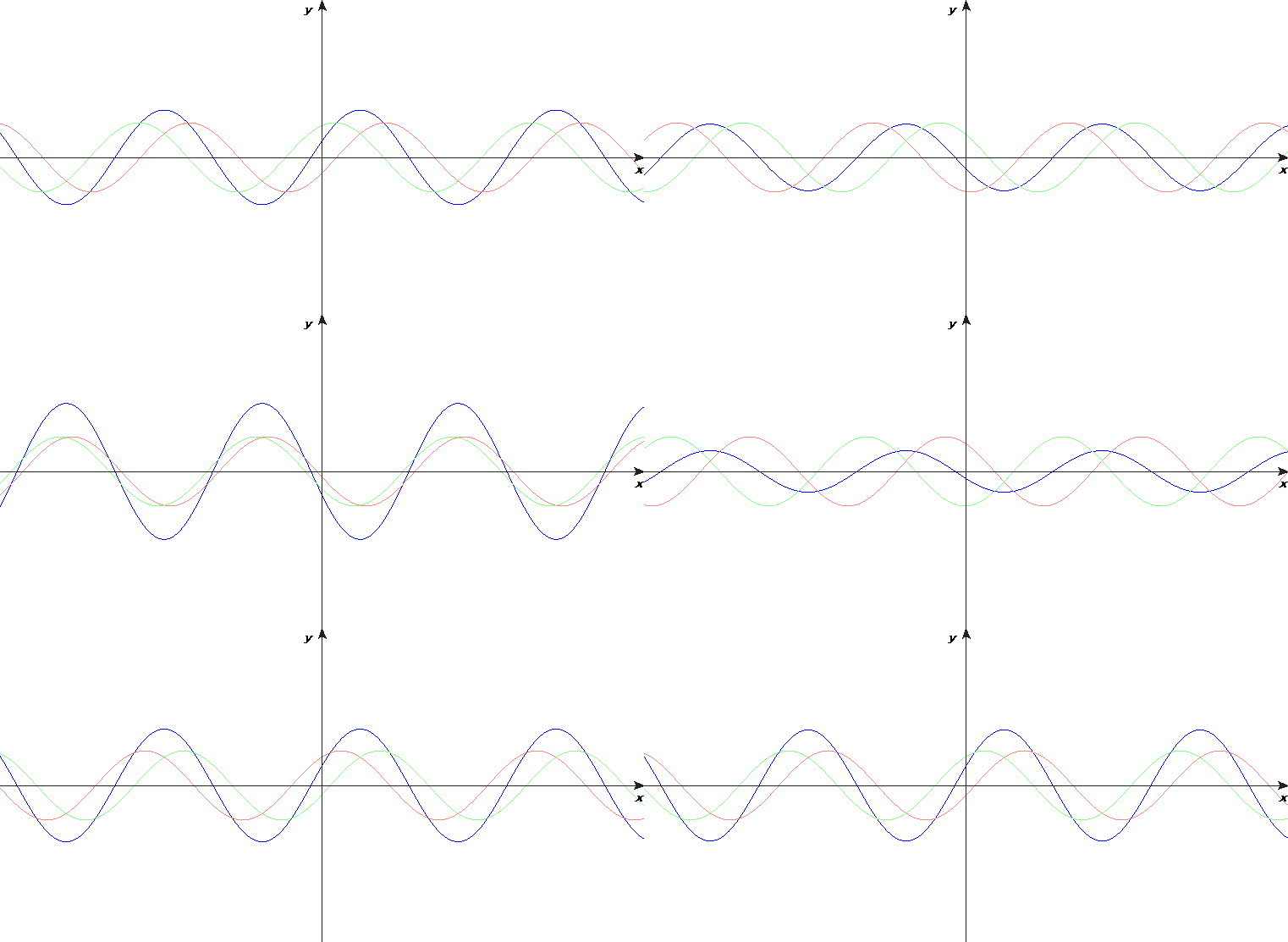
Recall my post on standing waves? The ones that look like this:
This shows how two waves can come together to form what appears to be a static oscillation in a medium. My example before was a rope, but now we're going to apply this idea to a rubber sheet analogy of space time.
For a start, space-time is 4-dimensional. It's not nearly so easy to imagine a wave in this environment, without lying a little to ourselves, and pretending the universe is one big sheet of rubber. I'm also assuming here the maths works out. I'm still at the beginner stages of tensor calculus, and so can't prove it yet.
The idea is this:
  • Gravitational waves are generated at two sources at a distance from each other.
  • As they move towards each other, they form a standing wave in between them.
  • The peaks in the waves add to each other to cause the necessary contortion of space-time.
  • Elsewhere in the universe, a similar event happens.
  • These two peaks join each other, as discussed in the previous post.
This is possibly how wormholes in New Eden are formed. From this model, we can now see why wormhole space is sometimes dominated by large mass objects, such as black holes and pulsars. These large objects are causing the necessary gravitational waves to produce natural wormholes. They are also "lowering" the surrounding space-time to make such peak to peak connections easier.
This also explains why wormholes have seemingly random destinations, whilst statics are known to remain in place.
Statics are locations in space where gravitational waves are somewhat constant. There is an ebb and flow of amplitudes, the energy of the waves, but these places are where standing waves can easily form. Essentially, it is a place where a number of gravitational waves comes together to form the peak needed to bend space-time into the wormhole bridge.
However, the exit location is not always the same. This is because, unlike the two black holes joining model, the other locations wave peak is not always fixed. What the static wormhole will do is fix itself to the "closest" possible wave peak. I say "closest", because at this point distance becomes a very tricky concept.
Imagine this: Rather than New Eden's space time being a fairly even and calm pond, like a smooth rubber sheet, it is more like a rolling ocean, with waves and tsunamis crashing around all the time.
See the area in between the two spheres?


A standing wave can readily form there, treating those two circles as fixed points. Now it's unlikely for a spherical object to produce a gravitational wave, so those two spheres really just represent wave generators.


The idea of random wormholes forming due to massive objects bending space-time doesn't work. For New Eden's wormholes to vanish and appear, we would need masses appearing and disappearing, seemingly at random.


But if these waves are so prolific in the cluster, shouldn't we feel the effects? Wouldn't time and space be warping all the time, making space travel, and just general communication a nightmare?
The reason we don't see the effects of gravitational waves, beyond wormholes, is that the gravitational waves are pathetically low energy. The only time they are strong enough to cause an effect on mass is when we have these standing waves, resonating and adding to each other to increase the amplitude of the wave.
 Now we can say why the Drifter wormholes and Sansha wormholes are constructed the way they are.

The structures are placed there to create an artificial gravitational standing wave, which can then link up to whatever location they desire.

We can also extrapolate from here, by saying that some ships may be able to carry gravitational wave generators to produce short term standing waves. These will not be as stable as the gated ones, meaning that only some locations are favourable.

If this is the case, we can now explain why the Seyllin Incident caused the appearance of random wormholes, and perhaps present a new perspective of the function of the EVE Gate itself.

Saturday, 30 January 2016

Wormhole Dynamics: Gravitational waves and Wormholes


So now we're going to bring this all together, which should present us with a good model for understanding wormholes in EVE, and from which we can extrapolate to both the mechanics of the Seyllin Incident, the mechanism of the Jove Dyson cloud network, and even the function of the EVE gate.


See, I told you it was a happy thought.


The idea behind wormholes, as predicted by relativity, is that 4-d space-time is manipulated in such a way as to create a bridge from one location in space time to the next.


I covered this already. The issues arise with that negative energy in the throat of the wormhole. Remember that the acceleration due to gravity is so strong there that not even light can escape, meaning that travel across it is fairly impossible. There must be some mechanism or some exotic matter to make that jump possible.


At least if you were a particle.


Waves, on the other hand, are all about the transfer of energy rather than the movement of particles. Indeed in a wave, although there's definitely something moving, particles do not, in fact change their location in the direction of movement. They oscillate up and down, but they don't go forward and back.


More on that in a second.


The wormholes are generally thought to be made by large masses causing contortions in space-time. Fairly simple to understand in terms of the rubber sheet model. You get two masses pushing down at the same time, and they may connect.


But that's not the only way to get a rubber sheet to move. And caveat  now, this is where the Science becomes mostly fiction. I'm not good enough to put the numbers to this hypothesis yet.


We can also get our sheet to move by applying a wave. In the case of space-time, a gravitational wave.


If we get the peak and trough of two gravitational waves to link up, then we can also create the bridge between two locations in space. Which is super exciting!

Placeholder for better image


The large mass model is static. Once the bridge is made, it's there until the energy is all lost from radiation of exotic particles. The formation of them also needs an awful lot of matter to cause the contusion of space-time. Not something a ship can reliably carry around with it.


The waves don't need as much mass, just an oscillation of local-space time. Ok, we need moving masses for this to happen, but the key point here is that the mass does not need to be IN the wormhole.

This goes a long way to describing how our ships can seemingly shift between locations in space at low energy. At the centre of the wormhole as we see it, our ships actually catch the anti-node of the wave as it becomes flattened into 'normal' space-time.


As the wave then oscillates back to it's peak, our ships are carried with it, and cross over to the other wave peak as it comes in. When the second wave flattens out again to 'normal' our ships are deposited back into a new location, and our autopilot moves us away from the peak area where this exchange happens.


This is why all ships have the same entry distance to wormholes, and larger ships with more mass appear further away. More massive ships must move further away so as not to be caught in the wormhole oscillation again. Less massive ships are less affected by the contortion of space time.


This now explains why wormholes in New Eden have a lifetime based on the mass of objects passing through. Massive objects around the wormhole act as dampening. The more massive objects that pass through, the greater the dampening effect. The energy of the wave is absorbed in moving the ships from one location to the other. Once enough energy is absorbed, the amplitude of the wave falls so that it no longer causes these bridges in space time.


It also explains why light from the other side of the wormholes is able to pass through without colour changes due to gravitational red shift. It is quite literally being carried from one section of space on the gravitational wave, rather than having to pass into and out of a very high gravitational field.
It's also consistent with the ripple effect we see being emitted from wormholes. They move, rather than being static.


There is so much more to talk about, but I'll expose this to public opinion first. But if this is correct, or at least good enough for EVE, then we can now explain random wormhole appearances, ship board wormhole generators, the exact reason for the Seyllin Incident, and what the EVE Gate actually is.


Additional: If anyone can help me make a nicer image for this waves touching idea, please get in contact... I lack the graphical skills.


Friday, 29 January 2016

Wormhole Dynamics: Standing Waves

This is a bit of relatively simple Physics that you've most likely seen before, and has a lot of application in The Real World outside of the lab.


Warning: This may not look like much when it comes to EVE, but it is vital to understand this model of wormholes. Bear with me... it will all make sense soon.


You'll mostly be familiar with a travelling wave, like the gravitational ones we saw last time. These waves appear to move in a certain direction. The peak of the wave looks like it's moving forward.


Standing waves are exactly what they say they are... waves that appear to not propagate forward. The peaks still move up and down, but they're not going anywhere.


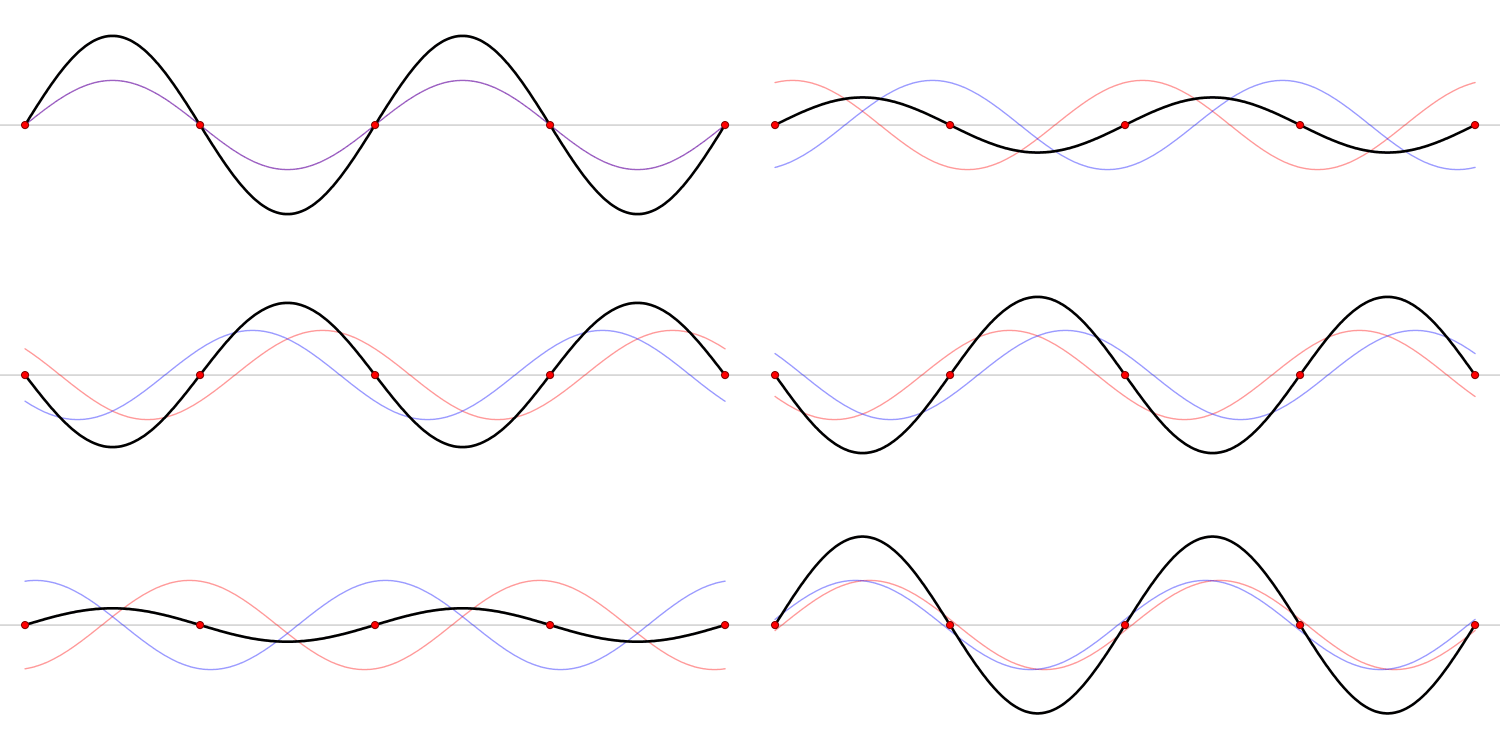
This is an example of one. See how it goes up and down but doesn't appear to travel?


Well this is actually what happens when a waves reflection is added to itself.


Imagine that thick black line is a rope, and you're at one end of it. Your flick the rope up and down, creating a little pulse down the rope. If it's not attached to anything, well, that pulse will just kind of disappear when it gets to the end.


However, if you then fix that end to a wall, the pulse will be reflected back at you.


If you keep moving the rope up and down, oscillating it, you will produce a travelling wave down the rope. Nothing you've never done before. Now imagine that the wave you send down the rope is the faint blue line in the image above.


Of course, the wave you send is going to be reflected back, just like the pulse earlier. That wave must travel down the rope just like the one you send. This is shown by the faint red line in the above image.


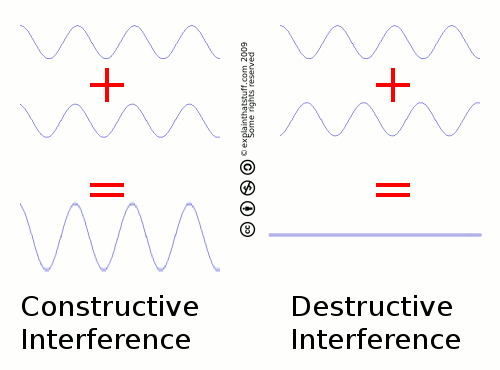
It turns out that waves that pass through each other just add themselves. So when the peak of the reflected wave meets the peak of the incoming wave, they add to produce a very big peak. If a trough adds to a peak, we end up with nothing happening.


In a standing wave, the peaks are always in the same place, and there are certain areas on the rope where nothing is happening. The stationary points are nodes, and the peak parts are anti-nodes.
This concludes our Physics lesson for today, and in the next post we'll start bringing these ideas together to my happy thought.


If you'd like to see a standing wave, grab yourself a piece of string now, attach it to something and start wiggling it. You should get a standing wave. If you don't have string, the best way to see a standing wave is to go get up on your feet, and go to a mirror. When in front of the mirror, raise your right hand (or left depending on dominance). Then, gently oscillate your hand back on forth. You should see someone doing a standing wave.


... You'd be surprised how many people won't get that.

Thursday, 28 January 2016

Wormhole Dynamics: Gravitational Waves

The first step to understanding this model, is to remember one of the basic ideas behind relativity.


Space-time is almost like a blanket or rubber sheet, stretched across... um, we'll leave that analogy there. But imagine it as a stretched sheet. Put some massive objects on it, and it will distort the sheet, giving some nice gentle valleys and pits. Gravity is merely the acceleration experienced by an object as it falls into one of these pits.


This was Einstein's idea, and spawned a vast array of new and wonderful ideas and hypotheses, one of which was gravitational waves.


Put simply, the sheet can have waves moving across it, just like waves on the surface of the ocean. These fluctuations in space time are gravitational waves.


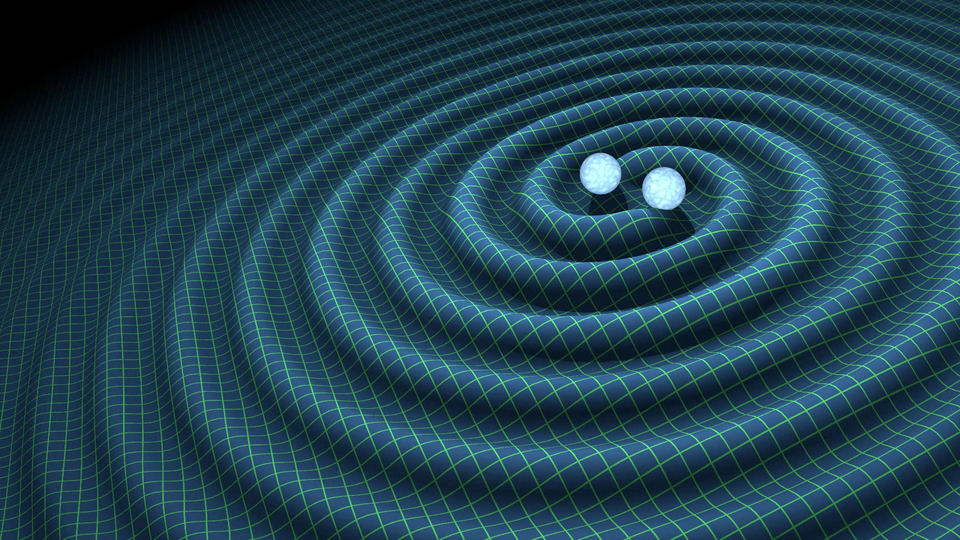
These ripples can be generated by two massive objects orbiting each other, as shown by this picture here of two neutron stars orbiting each other.


See how the distortion in space time propagates away from the stars?


These are phenomenally hard to detect, and there is a search right now to find them. The evidence we have for it now really just involves seeing a slow down in orbital speeds of two known neuron stars orbiting each. This lost energy must go somewhere, and it is believed it's carried off by this gravitational waves.


The reason they are so hard to detect is because gravity is actually a fairly weak force. It takes an awful lot of matter to make an appreciable gravitational field (which you know, since it's taking the whole mass of the Earth to keep you from flying into space...). The gravitational wave is obscured by all the other forces around us. Even my above example is in dispute.

However, in New Eden we already have fairly hard evidence for things which should only be hypothetical. Black Holes are merely mundane window dressing to wormhole corps shenanigans, and wormholes themselves are prolific to the point of common feature. What I am suggesting, and will be building from, is the idea that gravitational waves are not only present in New Eden, but actually strongly affecting the cluster.

Wednesday, 27 January 2016

Wormhole Dynamics: A happy thought...

Every so often, the hundreds of thoughts you have per day neatly line up into one coherent idea.


It happened to me a week ago, and I've been happily doing the crunching and analysing for the past few days.


The first thought that came in was when I was preparing a lesson on Standing waves for my students. They're not too tricky to wrap your head around, but the maths can look difficult if you're not used to describing with equations. Typically this is where we sort the experimental from the theoretical Physicists (the engineers having bee identified from the previous topic on microwaves, and measuring the speed of light using toast and a microwave oven).


I was just looking for some examples of standing waves that were different from the normal laser and musical instrument stuff, and came across a gravitational wave. Quite cool, but not really what I needed, so I moved on.


In the evening I happened to read up this post from Rhavas, talking about the latest chronicle, and the sweeping conclusions to months, and indeed years, of research and analysis. In it my own findings of a closed wormhole system were confirmed, along with my reasoning for it. He, and a number of commenters go on to predict doom, gloom, and the coming of a super-powerful race of technological wizards.


I read, and in typical capsuleer fashion, wondered just how such a new race would eventually be farmed for scrap and loot.


It did bring back to the fore of my mind, just how prolific wormholes in New Eden are, and sent me back to my project of understanding how wormholes worked in our cluster. The recent chronicle had confirmed that they were mostly artificial, a remnant left by accident or design from the Talocan.
After butting my head against the same brick wall for a few hours, trying to get everything to work, I gave up in frustration and turned on the TV.


As luck would have it, The Big Bang Theory was on, a re-run of an old episode. You, of course, are entitled to your own opinion, but as a Science teacher and eclectic nerd, the show resonates with me. And in this particular episode, Sheldon was equally frustrated with a problem he couldn't solve with his examinations of electrons moving through graphene, which was definitely something I could relate to. The punchline is him standing in the middle of a restaurant amongst shattered plates and exclaiming wildly, "It's a wave! A wave!"


And that's when I had my happy thought.


It IS a wave, isn't it... 

Monday, 6 July 2015

Wormholes: Closed network

This isn't going to be long, as it's a fairly easy observation (and doesn't require a single shred of maths!).

The New Eden wormhole system is a closed network. Put simply, at this stage of wormhole exploration, we know that there are a finite number of systems that are reachable by wormholes. These generally receive new connections every few hours... quite a regular event for a natural cosmological phenomena.

What's more, is that the locations of these wormhole systems, whilst we cannot tell their distance or relation to the populated systems, are all generally in the same parts of space. This again, is a fairly simple observation to make: looking out at the surrounding nebulae of wormhole systems we can see that they share features and colour spectra.


Knowing this, we can deduce a few possibilities.

Locations of natural wormhole viability

It could be argued that these areas of space are places where wormholes are particularly viable. Perhaps something to do with the presence of large mass features (pulsars, black holes etc.), these just may be locations where space-time more readily folds in on itself,

It can then be argued that the Seyllin event led to the New Eden cluster becoming suddenly more susceptible to wormhole formation.The exact mechanism of this is definitely something that deserves more research, and means that wormholes are more likely to be natural phenomena. 

Artificial wormhole network

A somewhat more extraordinary possibility would be that the wormholes we experience in New Eden are in fact constructed. Much like our own jump gate network, each system connected to wormholes already appear to be inhabited. 

We don't find many completely empty systems... and in fact there are some systems in New Eden which are even less populated than wormholes. A short trip through even High security empire space will show you transit systems, with some asteroid belts, temporary anomalies and a pair of jump gates. In comparison, wormhole systems appear to be stuffed full of Sleepers.

This hints that wormholes are actually a network to settled systems. If they are artificial, then it would explain why there are some features of wormholes not predicted by relativity. Or, you know, relativity is wrong. 

The middle ground

Odds are that the answer lies somewhere in the middle of these two extremes. The Sleepers created a technology allowing them to create wormholes, and those more densely inhabited systems (Class 6s) are simply systems where exit wormholes form more readily.

If New Eden was not originally a place where wormholes formed easily, then it's reasonable to assume the Sleepers left the cluster, and simply closed the doors behind them. The Seyllin event, as destructive as it was, re-opened those doors.

What might be more relevant is that the wormhole network became unstable. We have seen over the years the number of wormhole connections across New Eden increasing. Low sec connections recently increased, and some scientists have predicted Null-sec systems are about to be affected in the same way.

This increasing destabilization of the wormhole network is already opening up new systems previously inaccessible to capsuleers. It may be that there are some systems that were also locked away by Sleepers... systems housing dangerous, or criminal Sleeper factions. 

Maybe what we know as Drifters?

Pure speculation, of course. But something we can start looking for; structures that control wormholes for a start. But something even better, would be structures, or destroyed structures designed to inhibit wormhole creation. The Sleeper equivalent of a Cyno inhibitor.

Evidence to look for:

Wormhole control structures (working or wrecked)
Common features between newly opened wormhole systems
Maps and terminal stations

Additional: I can't find the dev blogs or forum posts for changes to wormhole spawn rates in low and null sec. I've seen other writers talk about them, but I can't find actual evidence of it. I'd appreciate someone find me the links, to prove to myself that I didn't just dream them.

Tuesday, 9 June 2015

Wormholes and light

After looking at gravitational lensing, and seeing how, in terms of General Relativity, light acts under a gravitational field, I've found something rather interesting with the wormholes in New Eden.

If you fly to any wormhole, you can generally tell its destination by looking at it. We can see the some of the distant nebulae of the joining system. 


This one is from earlier. You can see the grey and reddish nebula in the middle.


A zoomed out picture for reference. The system of the observer (i.e. me) has the mix between red and yellow nebulae you find in between the Empire and the Republic.

The issue is this... the light is the same colour as the nebulae on the other side.

Sounds absurd to argue that, and clearly the light is being affected. However, you need to know that light acts a little different in gravitational fields than other objects.

Let's do an experiment: Drop something. Go ahead, I'll wait.

It should have dropped to the ground right? That object (and I hope it wasn't expensive) starts accelerating to the ground. It's losing gravitational energy, and transferring that to kinetic energy. The velocity increases.

Light as it falls towards a gravitational field also gains energy. But it's light. It's already going as fast as anything can go. Photons are too small to fit acceleration gates or traditional warp engines. It simply can't go any faster. That additional energy needs to go somewhere.

To understand what's going on here, we need to know an equation:


E = energy
h = Plank's constant
c = Speed of light
λ = wavelength

Plank's constant and the speed of light are both physical constants. We can't change them. This means that Energy has an inversely proportional effect on wavelength. More energy results in a shorter wavelength. Less energy, larger wavelength.

Here's a diagram of the EM spectrum. Larger wavelengths of light are on the right, shorter ones are on the left.

As light comes closer to the wormhole, we would expect it to get more blue. As it moves away from the hole, we'd expect it to get more red. 

We don't see light coming through the wormhole changing colour, regardless of distance from the hole.

This means that light is energy balanced coming through. 

This is weird. 

It's almost as if light is unaffected by the hole's gravitational field... at least in the center of our perspective. But we know that objects exiting the wormholes are affected by their mass. Larger ships tend to be ejected further away from the wormhole than smaller ones. Mass also affects wormholes. More massive objects destabilize wormholes faster.

And we still have the gravitational lensing effect, as predicted by General Relativity around the hole. We even see some ripples within the center of the hole, which suggest the lensing effect there.

This needs further observation to find out what's going on here. Why? I do not believe these wormholes to be natural phenomena. I believe them to be constructed, but out of control. And above all, I believe I am having a lot of fun learning the maths behind all of this! 

Seriously, I'm learning how to do tensors. Up until now I hadn't even heard of them!

Update: I should point out that the increase in energy is actually due to time dilation. Just needed to make that distinction to the analogy I gave above. Light is affected by gravitational fields, but not in the same way as objects with mass.

Friday, 29 May 2015

Drifters, Wormholes and General Relativity

You may be wondering why I think understanding the hard Physics behind worm holes is important.

Well, the first reason is that I love dissecting the universe around me.

The second reason are these guys:


Drifters. You may have seen them wandering around scanning things. I want to look at them in more detail, but for now I'll focus on this part of the battleship.


Notice they don't have traditional engines.

Looking closely at them we can see light bending in odd ways around these spikes, which occasionally twitch as the Drifters move.

What does this mean?

Well, it's a phenomena we see quite a lot around wormholes.


Look at that beauty of a shot! The nebula on the right side is almost entirely bent around the wormhole, so we can see it on the other side.

Now, we know this is not refraction, or reflection. There is nothing for the light to reflect off there, and if it were diffracting through some medium (which we don't observe anyway) we would expect to see some differences in wavelength, or some splitting of the light. We don't see this... the observed colour stays the same.

So what's going on here?

The light is being bent by gravity.

Which doesn't make much sense! Gravity is a force of attraxction between objects of mass. Light, has no mass. So how is it being bent around?

Well it's to do with the principle of equivalence.

In my last post I talked about the acceleration on an object caused by gravity, and I did some maths to support the theory using planets in a low-sec system. So, you should be happy with the idea that a object subject to gravity experiences an acceleration pulling it towards another object of mass.

Put simply: Big planet pulls you down.

But acceleration doesn't just happen due to gravity. The more commonly observed version of acceleration is seen in space ships going quickly!

So, imagine these two situations: capsuleer on a planet (in a gravitational field), and capsuleer in a Rifter accelerating away.


(Apologies for the picture of the Rifter. I still need to plug in the Advanced Photoshop skill book...)

If the pods camera drones weren't working properly, there'd be no way for the capsuleer to know if they were on the planet, or in the Rifter. Both are experiencing the same force pulling them down. In effect, we can see that these two situations are entirely equivalent to each other. Principle of equivalency.

This helps us to visualize what would happen to a beam of light moving across the Rifter when it's accelerating. So, let's have a Punisher get a wrecking shot on the Rifter.


As the beam moves across, the Rifter moves a little further forward. For the poor capsuleer about to eat hard vacuum, it looks like the beam is curving into the direction of the force pulling the capsuleer down.


The accelerating Rifter and the capsuleer on the planet are in equivalent situations. Therefore, light is curved into the direction of the pull of gravity.

Going back to our Drifter: since we can see the distortion of light here, with no apparent medium, we can say that the Drifters use some kind of manipulation of gravity as a method of propulsion.


See the way the Concord battleship bends to the rear of the Drifter? The direction of gravity is being pulled towards the rear of the vessel. Kind of weird, but this detail can be examined later.

For now, it's fairly obvious that Drifter propulsion is based from gravity.

Further study

Would Gallente gravimetric sensors be better at detecting these Battleships?
Do Drifter weapon systems operate on the same principle?
This is true for sub-light speeds. What do Drifters do the achieve warp?

Wednesday, 27 May 2015

Wormholes: Basic Gravity

... or just making sure the laws of Physics are consistent in the cluster before going forward.

I had to do maths today, so to make up for it, here's a picture of the ISV Rhys Tai, my current ship.


Beautiful shot of Caroline's Star in the background.

I started with the assumption that gravity as we know it still applies to New Eden. If I were thinking meta-game, I doubt the developers would create a whole new set of Physics to create their universe. However, a lot of Physics does come down to constants, and once the equations are set, it's relatively easy to sneak some curve balls in in there.

So. Basic gravity.

The force of attraction due to masses of objects is ancient science.

These laws were laid down before even the Amarr and Khanid got off our planet. How they weren't lost under a deluge of religious dogma, I don't know. I can only hope reverence for the EVE Gate made such advances possible. But I digress.

The equation is relatively simple:


This is where m1 and m2 refer t the objects being attracted to each other, and r is the distance between them. G is a universal constant, used to equate mass, distance and force. And that's what we just need to test now. 

If that G constant is different then we essentially need to start all over again understanding New Eden Physics. Happily, testing it really isn't that hard for a capsuleer! 

The part of the equation we need to test is this bit in red:

This bit describes our surface acceleration on a planet.You might have seen this as a 'g' back in school (usually as a very human friendly 9.8m/s^2).

As capsuleers, our pod and ship sensors give us access to a whole bucket load of information we'll never need. Fly out to a planet, and check its information, and you can get its mass, radius, and even its surface gravity. Which means we can safely check our equations work, without too much hassle.

So that's what I did. 


These are some planets in the Shamahi system. Low-sec in case you were wondering. There's also Shamahi 9 up in the first picture of this post. Well done to Angry Gamers Incorporated for securing some POCOs in this system!

I checked the data, did the maths, and good news! Our basic equations for gravity, and the constants used hold up in the cluster... at least for this system. To be sure, we still need to check if this holds up in more exotic spaces (wormholes and Thera in particular).

But for now, I'm satisfied that my basic understanding of gravity can be applied in New Eden. I wasn't really expecting to find anything different, but it's always a good idea to check the basics before running off into black holes.

Now for General Relativity, and seeing which parts match up to our wormholes.

Thursday, 21 May 2015

Wormholes: Basic function

'Basic' in this case being a relative term. But not a specific relativistic term... Or a special relativity term.

Wow, I managed to get confusing in the first paragraph. Let's start again?

Low-sec wormhole, captured from the deck of a Svipul scout destroyer

Wormholes are areas in space which allow you to travel from one point in space-time to a very distant one.

In practical terms, you go in one end, and pop out somewhere else, which could be theoretically on the other side of the universe. And in New Eden, that's exactly what it does. Scan it down, pass through, and you've found a short cut between Jita and Dodixie.

If all you're looking for is how to use a wormhole, then that's pretty much it. Nothing special, just a glorified jump gate.

According to the maths, it's not quite that simple. And I'll avoid maths as much as I can, and stick to description and analogy.

What's really important to remember is that this is all analogy. To really understand it, you need to know the equations. Language and human perception is simply not robust enough to comprehend what's happening. That's not to say you're dumb for not being able to, it's just that our imagination is more developed than our ability to perceive... one of the little quirks of the brain being primarily a predictor rather than a reactor.

You've probably seen this?


Makes it easier to understand.

Two things to remember:
  • The green grid represents 3D space-time.
  • Look at the yellow line. It does not jump off the green sheet. It follows it down the pipe.
You may have seen various sci-fi shows where you'll see ships zipping down tunnels. That's not really happening. You're not going to see a tunnel, and any wormhole resident will tell you that doesn't happen in New Eden.

You literally go in and come out... barring a few seconds where even the capsule can't process what's happening around it. No tunnel effects like you get from a jump gate, or acceleration lines you'd see from a intra-system warp.

Wormholes in New Eden aren't like acceleration tubes. They are literal short cuts. The best analogy is just a tunnel through a mountain. You still go at walking pace. It's just that the distance is shorter.

Here's a nice piece of evidence to show this:


Light passes through from the other side off the whole. We can see the system on the other side... I believe this one is a C4? You can identify them from the colour.

However, and I'm going to say this a lot... it's not that simple.

This, in fact, is kind of weird.

Light isn't acting as expected, or at least as far as my limited knowledge at this stage goes. I need more information. Time to hit the books, and do more research to understand what I'm seeing here.

But for now, that's a basic overview of what a wormhole does.

Just as an aside, if I start talking about things that you don't understand, please let me know. I teach Physics now, and there are certain things I just assume people know. If you could comment on bits and pieces that confuse you, or you simply weren't taught, it's actually going to help me outside of the pod, and help me deliver better lessons to students.

Wednesday, 20 May 2015

Understanding wormholes


Whilst looking through exotic matter hypotheses to solve our antikythera conundrum, I re-visited my old literary stomping grounds of wormhole theory.

I'll get the connection out of the way, so that others can begin wild speculation: traversable wormholes, in order to satisfy general relativity, need some exotic matter of negative density to keep them open. I won't even pretend to know the details or the maths behind it, but I may come back to it at some point.

The tinfoil bait? Antikythera could be an exotic material used to keep wormholes open.

Not really so far-fetched an idea. Our jump gates rely on similar technology. However, since its being used to make Entosis links, it does look unlikely.

Either way, I started looking at wormholes again.

Like any true nerd, I grew up thinking I knew more about the universe than I actually did, and delusions of my academic prowess led me towards reading Physics journals far above my level. Needless to say, I did not understand half of what was there.

And I still don't.

This is a problem.

Especially since I just used a wormhole to get from Molden Heath to Genesis yesterday.

And I get the feeling that wormholes are going to play an even more significant part of New Eden's development from this point on.


And I think looking a little more closely at this theory would help us to understand just what the EVE Gate is.

And to keep things at least a little interesting, I'll get some pretty pictures of wormholes to go with it!

Friday, 18 April 2014

A brief oddyssey

Occasionally I get the deep desire to go to wormholes.

And why not? They're exciting places. New space, with weird and wonderful creatures infesting their lonely space lanes. Almost unspoiled systems. And treasure. An awful lot of treasure to be found.

I jumped in my Astero to find the nearest wormhole I could, and go looking for treasure.

And the first one was 2 jumps out of Hek!

I leapt inside and...

Found myself in low-sec. Thrilling.

Well, treasure turns up in odd places. I warped out to a nearby belt to make a safe-spot.

Quick tip: Making a safe spot in every system you come into is a good habit to get into to. Never know when it might come in handy. The procedure is simple: bookmark your location in warp. Their are four levels of safe:

  1. A bookmarked location between two known orbitals (stations etc.). 
  2. A bookmarked location between a safe and a known orbital. 
  3. A bookmarked location between two safes.
  4. A bookmarked location out of D-Scan range from the furthest orbital of the sun (now all but impossible to get).
Anyway, at the belt I found the wreck of a clone pirate. Un-looted. Clearly someone got scared by me entering system, and left even the very valuable tag inside. Nice.

So, with a hold suddenly worth a great deal of money, I dropped back through the wormhole to the tune of 10 million ISK. Not bad for what amounted to a few system jumps.

It did start me thinking though. I have been spinning my heels around Metropolis and the Crusade stomping grounds for a bit too long. And my Rifter experiments haven't born much in the way of good news. 

Maybe it's time for a change of pace.

Monday, 7 October 2013

Strategikon: Anoikis

Early Khanid culture shares a surprising amount with Early Gallentean. Whether this denotes a common ancestry or not is beyond my feeble scholastic skill, but there are clearly parallels to be drawn. The way the Gallente name their ships is taken straight from this shared cultural background, despite their extremely different naming conventions for systems.

The Khanid are an odd, mongrel race, claiming deep historic ties to Amarrians, shared language with the Gallente, and even an Pre-Stellar age nomadic lifestyle similar to that of the Minmatar. Throw in the Kingdom's more modern acceptance of Caldari technology and business practices, and you have a race robust enough to be at home in all environs.

Which is perhaps what has interested my King in Anoikis, or Unknown Space.

Despite the antique look of the word, Anoikis is actually a modern fusion of some ancient Khanid or Gallentean phrases, and is translated as 'to be without a home'. Very fitting for those systems only accessible by a wormhole.

As a simple aside, anoikos is a recorded word of antiquity, meaning 'homeless wanderer'. Given the conspiratorially nature of Anoikis lore, loose connections such as this should be noted.

The very word Anoikis hints that these places are actually some kind of place of exile, and there are at least a dozen conspiracy theories to explain this. It's also a medical term for a stage in the development in cancerous cells, with a dozen theories for that too. Then again, there are theories of all kinds surrounding wormholes, and don't really give us any guide lines for success.

Here is what you need to know:


  • Do not speak in local
  • You MUST bring a probe launcher
  • Stealth is helpful.
  • D-scan all the time.


The capsuleers that have moved into Anoikis are a paranoid and highly disciplined bunch. They live far removed from the comforts of Empire run stations, living out of POS stations and often leaving ships hanging in space with only a shield to protect them. The above is taken from listening to them.

Local broadcast only shows ships that start communicating. You have a certain degree of anonymity by not taking in Local. I intend to break this rule eventually, but I wouldn't recommend it for those who want to survive.

There is no way to locate a wormhole without a probe launcher. If you jump into Anoikis, and forget to bookmark your exit wormhole, and you don't have a probe launcher, you will need to destroy your clon to make it back home.

Stealth will reduce the chances of ships scanning you down. It's not a perfect defense, so make sure to use your mobility defense. Keep moving.

D-Scan all the time. You can see probes searching for you, and either run or cloak up. I suggested retrograde maneuvers.

I'm looking forward to my first solo steps into a wormhole. I'm also enjoying reading the mysteries that surround the history of these phenomena. But first, I'm going to need some scanning practice.


Saturday, 5 October 2013

Back to New Eden

Well, that was a little longer than I thought!

Other duties demanded more time than I could give to commanding my ships. And in truth, I was not the most motivated crusader.

New technologies are on the horizon, meaning that new opportunities have arisen. My King has pulled me from the front lines, determining that my efforts are best spent elsewhere. I have yet to decide if this is a demotion or a boon granted to me.

His new orders are to explore Wormhole space.

I believe this to be a death sentence. But an Arcani never sways from a Royal Decree. They merely take extended leave from duties.

I once lived in a wormhole, standing with the once great Talocan United. I left after a few weeks though. I could not give the corporation the time necessary to perform well. It also felt far too restrictive. Too many rules and standard operating procedures, and too many calls to arms for people I barely knew.

This time, I will approach Anoikos on my own terms. I am going to fly solo.

Yes this is suicide. But many would have called flying a lightly tanked Executioner against a Firetail suicide. I look forward to proving people wrong.

The blog site will be refurbished, for no better reason than I like refurbishing it. I always say you need to look the part to play it, and I'll be tweaking things to show a more adventurous spirit. I may or may not include an antique compass.

There are secrets in wormholes. My King wishes to know them. I wish to seek them. Lets see what we can find!