Thursday, 28 January 2016

BB 71 - Decision Fatigue

For more details about what the blog banters are please visit the Blog Banter page.
Too Many Ships Spoil the Sandpit?

We all like important internet spaceships right? The more spaceships the better right? Or are we getting too many to be easily to remember them all. A Mastodon on scan? That the hell is that and what does it do? Oh! Never mind!
Are we getting too many ships. Is it too complicated to remember them all and what their traits are? Do FC's these days need an encyclopaedic knowledge of ship types unless they want their fleet to DIAF. With more and more ships being released each year will we ever reach "too many" or do you think there can never be too many important internet spaceship types?
Banter on!
 
I'll take a short break from Physics to talk about Psychology.

As a numbers and EFT Warrior nerd, I'm generally in favour of getting more ships in space. The mere mention of a new destroyer or frigate is enough to get me excited, and blasting out into space. More usually it's just going to give me more glorious hours with the spread sheets, trying to calculate the most efficient fit.
 
But, I do know it's not always the best thing for a player.
 
I'm sure someone else will get on to power creep and redundancy of role, and even market saturation. What I'd like to look at is the idea of decision fatigue.
 
Consider the dressing habits of two men, who we'll call Alan and Bob.
 
Alan wears suits to work, and has a home clothes and weekend rotation of 5 jeans and 5 t-shirts. He has 3 jumpers for when it's cold, and 1 coat for when it's freezing. He has 2 pairs of shoes, one smart, one comfortable.
 
Bob has suits, blazers and smart style jackets for work, with a variety of tie styles for work. He has a walk in wardrobe full of clothing for home, and has generally worn each garment 3 or 4 times. His winter clothing is carefully selected to coordinate with each other, and his shoe rack extends the length of his bed room.
 
If you see these two gentlemen together, you will have no doubt that Bob is better dressed. Alan is rather plain in comparison. But over time you will notice Alan coming in to work, on average, 10 minutes earlier than Bob. Not only that, but Alan's productivity is 10% better than Bob's, even though they will be putting in the same effort.
 
It comes down to this idea of decision fatigue. Bob, before he even leaves the house, must decide which set of clothing he will wear that day. Which tie goes with this shirt. Can I wear a jacket, or should I switch to a suit. Do these shoes coordinate with the suit I've put on. This coat works well with these shoes, but now I need to change my shirt.
 
Alan throws on whatever is in his rotation and is out the door, having made no decisions that day.
 
The exaggerated example there shows the results of decision fatigue. The more decisions you make will lead to an eventual deterioration of the quality of your decisions.
 
Decision fatigue can lead to a few problems.
 
  • Reduced ability to make trade offs: You tend to make poorer cost-benefit conclusions because you're tired of decision making.
  • Decision avoidance: It's exhausting already, so you simply don't make the decision.
  • Poor self-regulation: Your discipline is reduced, and you tend to take easier options.
  • More impulsive behaviour: You take your first conclusion, rather than think about a problem.
 Bringing this back to EVE, having a glut of ships and fitting options forces you to make a hundred decisions before even undocking. Before you've really started the game, you will already be making poorer decisions, and starting to feel the effect of fatigue.

I'm sure all of you will have noticed the above behaviour in your piloting at the end of a session.

Much worse, if it takes you too long to select and fit your ship, then you simply may not undock at all. You will have made yourself exhausted by the fitting window alone, and the thought of jumping around star systems for a fight is just... tiring.

The additional problem to this is timing; the more time you spend in the market browser picking the frigate you want to fly that day, the less you're spending in space.

And yes, this problem is doubled for FCs, who will not only need to consider individual ships, but also fleet composition, and role of each capsuleer.

It's a delicate balancing act. Good gameplay is all about making meaningful decisions. You feel good about choosing that rail gun over the blasters when you kite a Comet to death in your Atron. But you do need to make sure there's not too many decisions before an outcome is made.

My advice: Don't think too hard about it. Have a stack of a ship and fit you like, burn your way through it, then start again. Decision making is only fun when you find the result of it, be it good or bad.
 
 All right, back to Physics, and building my new model for New Eden wormholes.

Wormhole Dynamics: Gravitational Waves

The first step to understanding this model, is to remember one of the basic ideas behind relativity.


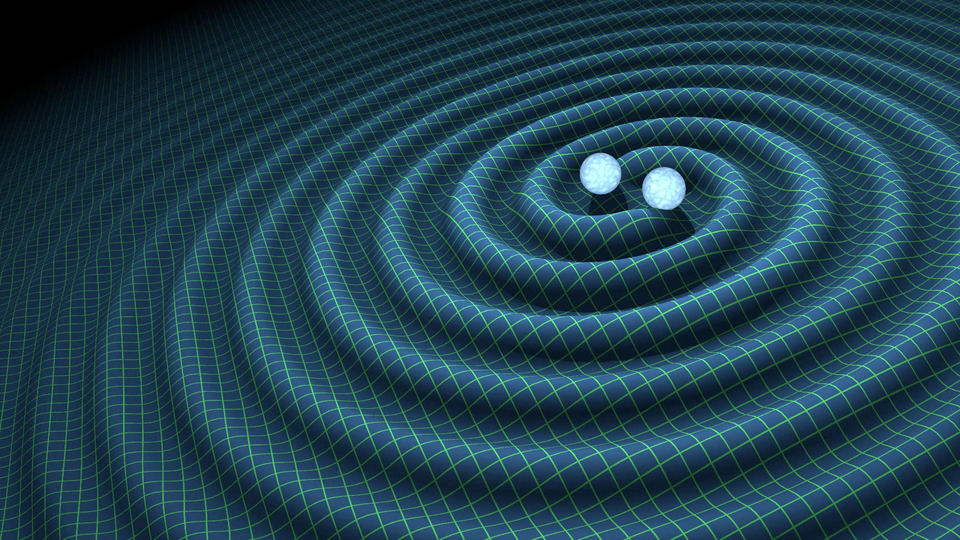
Space-time is almost like a blanket or rubber sheet, stretched across... um, we'll leave that analogy there. But imagine it as a stretched sheet. Put some massive objects on it, and it will distort the sheet, giving some nice gentle valleys and pits. Gravity is merely the acceleration experienced by an object as it falls into one of these pits.


This was Einstein's idea, and spawned a vast array of new and wonderful ideas and hypotheses, one of which was gravitational waves.


Put simply, the sheet can have waves moving across it, just like waves on the surface of the ocean. These fluctuations in space time are gravitational waves.


These ripples can be generated by two massive objects orbiting each other, as shown by this picture here of two neutron stars orbiting each other.


See how the distortion in space time propagates away from the stars?


These are phenomenally hard to detect, and there is a search right now to find them. The evidence we have for it now really just involves seeing a slow down in orbital speeds of two known neuron stars orbiting each. This lost energy must go somewhere, and it is believed it's carried off by this gravitational waves.


The reason they are so hard to detect is because gravity is actually a fairly weak force. It takes an awful lot of matter to make an appreciable gravitational field (which you know, since it's taking the whole mass of the Earth to keep you from flying into space...). The gravitational wave is obscured by all the other forces around us. Even my above example is in dispute.

However, in New Eden we already have fairly hard evidence for things which should only be hypothetical. Black Holes are merely mundane window dressing to wormhole corps shenanigans, and wormholes themselves are prolific to the point of common feature. What I am suggesting, and will be building from, is the idea that gravitational waves are not only present in New Eden, but actually strongly affecting the cluster.

Wednesday, 27 January 2016

Wormhole Dynamics: A happy thought...

Every so often, the hundreds of thoughts you have per day neatly line up into one coherent idea.


It happened to me a week ago, and I've been happily doing the crunching and analysing for the past few days.


The first thought that came in was when I was preparing a lesson on Standing waves for my students. They're not too tricky to wrap your head around, but the maths can look difficult if you're not used to describing with equations. Typically this is where we sort the experimental from the theoretical Physicists (the engineers having bee identified from the previous topic on microwaves, and measuring the speed of light using toast and a microwave oven).


I was just looking for some examples of standing waves that were different from the normal laser and musical instrument stuff, and came across a gravitational wave. Quite cool, but not really what I needed, so I moved on.


In the evening I happened to read up this post from Rhavas, talking about the latest chronicle, and the sweeping conclusions to months, and indeed years, of research and analysis. In it my own findings of a closed wormhole system were confirmed, along with my reasoning for it. He, and a number of commenters go on to predict doom, gloom, and the coming of a super-powerful race of technological wizards.


I read, and in typical capsuleer fashion, wondered just how such a new race would eventually be farmed for scrap and loot.


It did bring back to the fore of my mind, just how prolific wormholes in New Eden are, and sent me back to my project of understanding how wormholes worked in our cluster. The recent chronicle had confirmed that they were mostly artificial, a remnant left by accident or design from the Talocan.
After butting my head against the same brick wall for a few hours, trying to get everything to work, I gave up in frustration and turned on the TV.


As luck would have it, The Big Bang Theory was on, a re-run of an old episode. You, of course, are entitled to your own opinion, but as a Science teacher and eclectic nerd, the show resonates with me. And in this particular episode, Sheldon was equally frustrated with a problem he couldn't solve with his examinations of electrons moving through graphene, which was definitely something I could relate to. The punchline is him standing in the middle of a restaurant amongst shattered plates and exclaiming wildly, "It's a wave! A wave!"


And that's when I had my happy thought.


It IS a wave, isn't it... 

Saturday, 19 December 2015

Risk aversion, and the costof thinking: Part 3

I didn't really intend for this to become a three part series, but out of looking at this paper some advice for pirates, or Faction Warfare militias popped into my head.


The goal of this advice is to reduce the cognitive load on people trying to enter PvP. By reducing that particular barrier, you will see a rise in the number of people fighting in your particular systems.


Getting new players in system


Stock the station market.


One of the biggest issues facing new PvPers, in particular for solo PvP, is the logistical problem of getting ship to combat zone.


My very first foray into Faction Warfare involved fitting up a frigate from my base station, and then making a 30 jump journey to the warzone. Upon entering, I had 2 minutes of delightful combat against a Rupture, and then blew up. I got him down to structure though, and drunk on this perceived success, I eagerly warped back to my base to re-ship.


I got about halfway before I realised I'd need to get all the modules for the ship again. And in my home base, that meant a trip to Rens to get everything. Transport it back to my base to fit up the ship. Then 30 jumps again to find a Rupture, most likely long gone.


In short, a lot of thinking to get back into the fight.


My next PvP encounter would be years later, when I assumed the title Khanid Kataphract, and really applied my brain to getting into PvP.


Anecdotal evidence, but it's my experience.


Just think what could have happened if all the things I needed were right there in that very system. I could have re-fit instantly, maybe gotten a second try at that Rupture, and maybe even my first kill mail.


Stock the local stations with goods. Allow newbies to simply bring ISK with them, and not an indy with everything they think they need. Not only does it reduce the starting costs of PvP down, but it means they can change their fits without wasting ISK.


For FW neutral markets can be a massive boost. Militias can be locked out of stations, meaning that assets can be locked away. Great for denying space from the enemy, but the problem there is you've denied space to your enemy. Why are you in Faction Warfare if not to PvP? Why then take actions that actually restrict targets from coming to you?


If you work very hard, and find your home base far from the front lines, you've basically turned your PvP arena into a deserted back water. It takes even more thought power to reach you, so why even bother?


If you want to have more PvP, make it easy for PvP to take place in your system. Stock the markets. Don't camp the jump gates. Don't mock in Local. Make your space somewhere people actually want to come to.


Reduce the effort it takes to get there, and people will come.

Friday, 18 December 2015

Risk aversion, and the cost of thinking: Part 2

Before we just looked at the cost of thinking as some of the background.


It's worth mentioning now, that this is mostly layman conjecture on a single paper, which is relatively recent. It's by no means a water-tight discussion from an expert, but rather the fevered ramblings of a pretend scientist on the internet.


That said, I hope some of this sparks a little bit of your own thoughts, or gives a little clarity to what you may be thinking about already.


Risk aversion to cognitive effort

Strictly speaking, this is a study of shifts in attention, and the perceived thinking effort that goes into it. If your attention is dragged all over the place, you tend to feel like you're being strained, or feel as though you are putting in a lot of work.


However, it does show an aversion to risky cognitive effort. It says that, given a choice between a safe, low thinking activity, and one which MAY require a high amount off thinking, people will tend to choose the simpler one.


Put simply, people don't want to find themselves in a position where they don't know how much thinking is needed.


I actually see this first hand in the classroom, particularly with students with Special Educational Needs. If they go into a lesson not knowing how much thinking they need to do, they will generally resist any attempts by you to teach them. Give them a set of criteria, and tell them directly what they will be doing at the start, and they will tend to put in effort.


This study also notes the difference between thinking effort and physical effort.


How many times have you heard the advice from solo PvPers: sometimes you just have to jump in and hope for the best. This is rationalised by these findings. Physical effort, actually getting yourself into combat, is usually rewarded with dopamine. That rush you get and the euphoria after a fight is a result of this reward.


This study tells us that there isn't as strong a link between a reward for thinking about a problem, as actually accomplishing it. Whereas that first fight you have will encourage you to do more, the thinking about the problem, even if a solution is successful, may not motivate you into more thinking time.


I'm not sure how valid a point that is, as my own experience tells me I enjoy analysis and logistical thoughts. So there is some more work that needs to be done there. But running with this idea that thinking effort is a detractor from activities, we can go on to the general risk aversion of EVE.


This means that a capsuleers risk aversion to more dangerous activities in EVE is not really down to a cost-benefit analysis of the physical cost, but rather the heavy thinking load involved in getting started.


Why do you think fitting guides and tactics advice are so popular?


Again, referring to mining. Mining as an activity is very easy to start in. You are hand held in the tutorials, and after less than an hours training, you are a successful miner. There are layers of mastery on top of that, but those layers of mastery are actually guided by ship progression. You work towards your first barge, then exhumer, then Orca. At the very beginning, you know how much thought you will put in, and where you're going.


Contrast that with PvP.


For Faction Warfare, you generally haven't got a clue where you're going, what you'll do when you get there, which ship you'll need, or what you'll do when it blows up. The preparation for entering even the most rudimentary PvP is, quite frankly, hard work.


In other words, what keeps people from entering EVE's PvP is less about risk aversion to money loss, but more about the aversion to the thinking effort needed to put in.


It's not really about losing the ship (although it does sting when you lose your shiny new faction battleship). It might be about knowing what to do afterwards, or even how to get into a situation where you can lose your ship.


Er... I mean, a competitive situation. Parking an indy about Jita's main station and shouting about the stack of PLEX in your cargo hold is a great way to lose a ship.


Next time, I'll discuss how, if you are a PvPer, can encourage people to actually come to your systems to fight.